

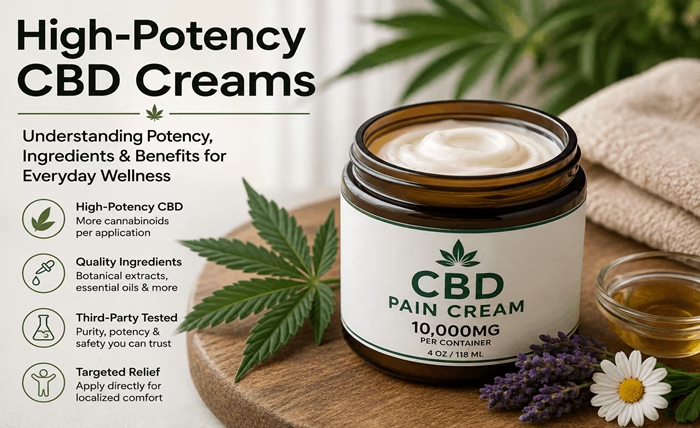
CBD topicals have changed dramatically over the past several years.
When CBD creams first became widely available, many products contained relatively modest concentrations of cannabidiol. Today, consumers can find everything from everyday CBD lotions to extremely concentrated creams, salves and balms containing thousands of milligrams of CBD.
That growth has created a new category within the CBD market: high-potency topicals.
But what actually makes one CBD cream stronger than another? And should consumers simply choose the product with the largest number on the label?
The answer is more complicated than it might seem.
What Is a High-Potency CBD Cream?
There isn’t a universally established definition of “high potency” when it comes to topical CBD.
Generally, the term refers to products containing substantially higher concentrations of CBD than standard lotions and creams.
Consumers may now encounter topical products containing 5,000mg, 10,000mg, 20,000mg or even higher amounts of CBD.
Those numbers can look impressive, but total CBD content only tells part of the story.
Container size is equally important.
A cream containing 5,000mg of CBD in four ounces will have a very different concentration than 5,000mg in a much larger container.
Consumers comparing high-potency CBD creams should therefore consider both the total CBD content and the amount of cream in the container.
Why Are Stronger CBD Topicals Becoming Popular?
One reason is simply that CBD consumers have become more experienced.
Someone purchasing CBD for the first time may begin with a relatively modest concentration. Over time, that person may start comparing formulations, ingredients and potency levels more carefully.
The market has responded by offering a much wider range of strengths.
Another factor is the popularity of targeted wellness routines.
Instead of taking an oral product, some consumers prefer applying a cream or balm directly to a particular area such as the knees, hands, shoulders, feet or lower back.
This has made topical CBD particularly visible among people interested in fitness, recovery, massage and everyday physical comfort.
CBD Creams Aren’t All Formulated the Same Way
Potency isn’t the only difference between topical products.
The base formulation can dramatically affect how a product feels on the skin.
A traditional cream generally contains water along with oils, emulsifiers and moisturizing ingredients. This creates a relatively lightweight consistency that can spread easily.
Salves and balms tend to contain more oils and waxes and may have a thicker texture.
Gels can feel lighter and may absorb differently.
Then there are additional ingredients.
A CBD topical might include:
- Menthol
- Aloe vera
- Arnica
- Botanical extracts
- Essential oils
- Vitamin E
- Carrier oils
- Moisturizing ingredients
These ingredients can have a significant effect on the overall experience.
Cooling CBD Creams vs. Unscented Formulas
One of the most noticeable differences between CBD topicals involves warming and cooling ingredients.
Menthol is frequently used in cooling creams.
Its distinctive sensation is familiar to anyone who has used traditional sports rubs or cooling gels.
Some consumers enjoy that strong cooling feeling, particularly after exercise or physical activity.
Others don’t.
Someone who wants to use a CBD cream before work, before bed or throughout the day may prefer an unscented formulation without an intense menthol aroma.
Neither approach is inherently better.
It’s a matter of formulation and personal preference.
More Milligrams Doesn’t Automatically Mean Better
The growth of extremely concentrated CBD products has created a tendency to focus heavily on milligram numbers.
But choosing a topical based exclusively on potency can be misleading.
A consumer should also ask:
How large is the container?
What type of hemp extract does it contain?
What other ingredients are included?
Is the product warming, cooling or neutral?
Is independent laboratory testing available?
How frequently is the product intended to be applied?
A 20,000mg cream isn’t automatically four times “better” than a 5,000mg cream simply because the number on the container is four times larger.
Different people have different preferences and reasons for choosing a particular strength.
Third-Party Testing Becomes Even More Important
As potency increases, accurate labeling becomes particularly important.
Independent laboratory testing can help consumers verify the cannabinoid content of a product.
These laboratory reports are commonly called certificates of analysis, or COAs.
Depending on the testing performed, a COA may provide information about CBD and other cannabinoid concentrations as well as screening for certain contaminants.
Consumers should be able to compare what’s advertised on the product label with what’s reported by the laboratory.
Transparency is especially important when companies are marketing products containing very high concentrations of CBD.
Look Beyond CBD Concentration
Another useful habit is reading the complete ingredient list.
For example, two creams could each contain 10,000mg of CBD but produce completely different experiences.
One might be an unscented moisturizing cream.
The other could contain a substantial amount of menthol and create an intense cooling sensation.
Someone purchasing based exclusively on the “10,000mg” number wouldn’t know about that difference without examining the rest of the formulation.
People with sensitive skin or ingredient allergies should be especially careful when trying unfamiliar topical products.
Patch testing a small area before widespread application can also be a sensible precaution.
What About CBD for Physical Discomfort?
Physical comfort is one of the major reasons consumers have become interested in CBD topicals.
However, marketing claims surrounding CBD sometimes go further than the available scientific evidence.
Research into cannabidiol continues, including research related to pain and inflammation, but consumers should be cautious about products promising to diagnose, treat or cure medical conditions.
CBD creams shouldn’t be considered replacements for appropriate medical treatment.
Persistent or severe pain should be evaluated by a qualified healthcare professional, particularly when it is unexplained or worsening.
The CBD Topical Market Is Becoming More Specialized
Perhaps the most interesting development isn’t simply that CBD creams are becoming stronger.
They’re becoming more specialized.
Consumers can now choose among:
Cooling creams.
Warming formulations.
Unscented products.
High-potency creams.
CBD and CBG combinations.
Thick salves.
Lightweight gels.
Products designed around massage and recovery routines.
This gives consumers more choices, but it also makes understanding product labels increasingly important.
Choosing a CBD Cream Comes Down to More Than Strength
High-potency CBD creams represent one of the fastest-evolving areas of the topical wellness market.
But the biggest number on the label shouldn’t be the only consideration.
CBD concentration, container size, formulation, additional ingredients, laboratory testing and personal preferences all matter.
For consumers interested in stronger topical products, understanding these differences makes it easier to compare options based on what is actually inside the container rather than simply choosing whichever product advertises the most milligrams.
As the CBD industry continues to mature, that kind of transparency and consumer education will become increasingly important.